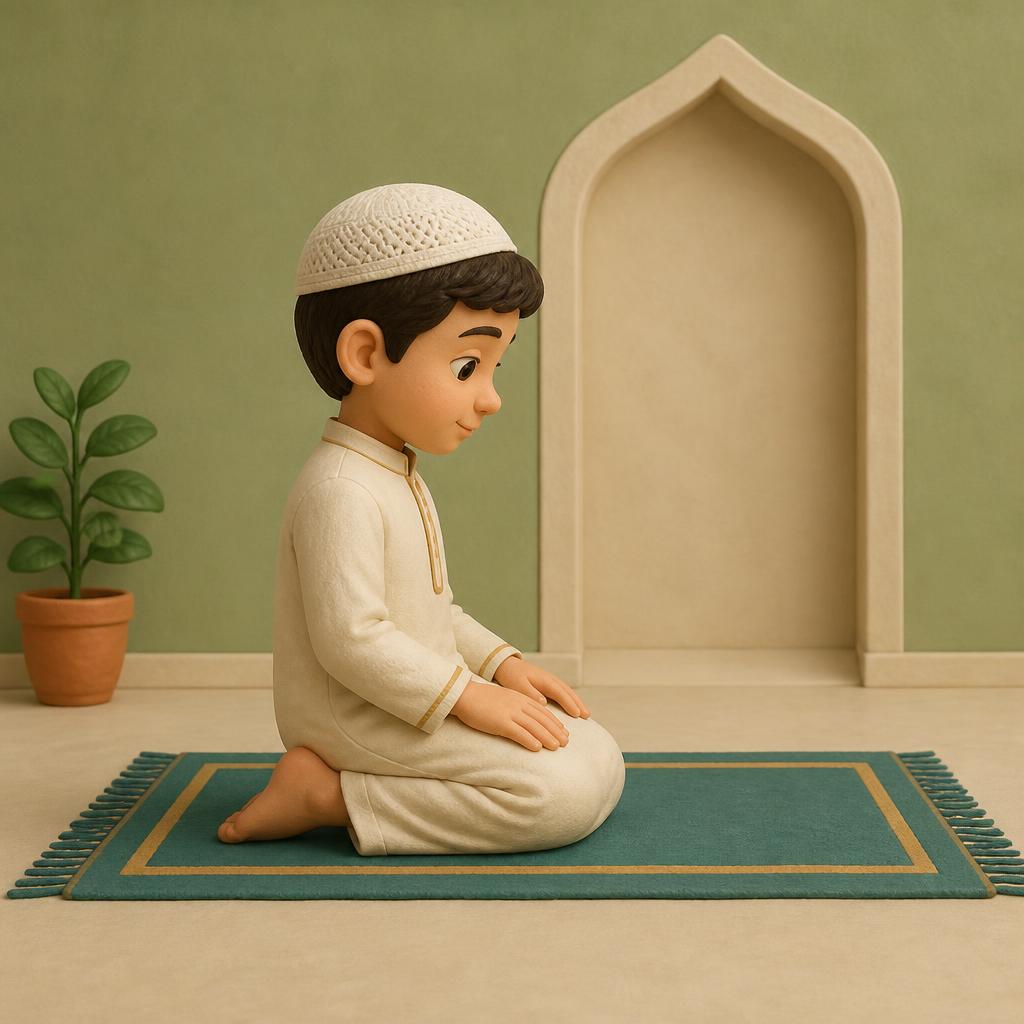
The positions of the prayer are fixed, but several of them accept more than one authentic wording. Build the set your child will actually pray, see the hadith behind every line, then drill it.
New to the prayer itself? Learn the positions first on the step-by-step salah page, then come back and choose your words. What you save here appears inside practice mode.
Step 1
Start from a ready-made set
Each set is one authentic choice per station. Pick the one that matches where your child is now, then change any single station underneath.
Step 2
Choose the words, station by station
The positions of salah never change. These are the moments inside them where more than one wording is reported from the Prophet ﷺ. Every option here links to the narration it comes from, so a parent or teacher can check it before a child learns it.
1. The quiet dua after the takbir
Optional — extra reward
Straight after you say Allahu akbar, before you recite
Abu Hurayrah noticed the Prophet ﷺ stayed silent for a moment after the takbir, and asked what he said in it. You can fill that pause, or go straight into Al-Fatihah.
2. What you add after Al-Fatihah
Optional — extra reward
In the first two rak'ahs, once Al-Fatihah is finished
Al-Fatihah is not a choice — the Prophet ﷺ said a prayer without it is invalid. What comes after it is where you pick. Choose a surah you can say without stumbling, and change it as you learn more.
3. What you say bowing
Needed in every prayer
While your back is flat in ruku
Three different wordings are reported from the Prophet ﷺ in ruku. Pick one and say it three times, or learn all three and rotate them so your ruku never becomes automatic.
4. What you say standing up from ruku
Needed in every prayer
As you come up straight, before sujud
Coming up you say Sami'a Allahu liman hamidah, then the praise. The praise has a short form and a long form, and both are reported.
5. What you say in sujud
Needed in every prayer
Forehead and nose on the floor, in both prostrations
The same three wordings that work in ruku have their sujud form — and sujud is the place the Prophet ﷺ told us to add our own dua after the tasbih.
6. What you say sitting between the two sujud
Needed in every prayer
Sitting up straight between the first and second prostration
This tiny sitting exists to ask for forgiveness. Hudhayfah heard the Prophet ﷺ say it twice, so the choice here is how many times, not which words.
7. The tashahhud
Needed in every prayer
Sitting at the end of the second rak'ah, and at the end of the prayer
Two wordings of the tashahhud are reported: the one Ibn Mas'ud learned, and the one Ibn 'Abbas learned. Both are authentic. Learn one properly; recognise the other when you hear it at the masjid.
8. Salawat on the Prophet ﷺ
Needed in every prayer
After the tashahhud, in the final sitting
Ka'b ibn 'Ujrah asked the Prophet ﷺ how to send blessings on him, and was taught these exact words. Younger children can start with the first half and add the second half later.
9. A dua before the salam
Optional — extra reward
After the salawat, just before you turn your face
This is the last window in the prayer. Two duas taught by the Prophet ﷺ fit here, and after either one you may ask Allah for anything in your own language.
Step 3
Your salah, in order
About 62s of words in one rak'ah, plus Al-Fatihah. Saved on this device, and used by practice mode on the salah page.
The quiet dua after the takbir
Straight into Al-Fatihah
Say the takbir, pause for a breath, and begin reciting.
Qul huwallahu ahad · Allahus-samad · Lam yalid wa lam yulad · Wa lam yakun lahu kufuwan ahad
Say: He is Allah, the One. Allah, the Eternal, on whom all depend. He does not have children, and He was not born. And there is nothing like Him at all.
At-tahiyyatu lillahi, wa s-salawatu wa t-tayyibat. As-salamu alayka ayyuha n-Nabiyyu wa rahmatullahi wa barakatuh. As-salamu alayna wa ala ibadillahi s-salihin. Ash-hadu an la ilaha illallah, wa ash-hadu anna Muhammadan abduhu wa rasuluh
All greetings are for Allah, and prayers and good things. Peace be upon you, O Prophet, and Allah's mercy and blessings. Peace be upon us and upon the righteous servants of Allah. I bear witness that there is no god but Allah, and I bear witness that Muhammad is His servant and His messenger.
Allahumma salli ala Muhammadin wa ala ali Muhammad, kama sallayta ala Ibrahima wa ala ali Ibrahim, innaka Hamidun Majid
O Allah! Send Your Mercy on Muhammad and on the family of Muhammad, as You sent Your Mercy on Abraham and on the family of Abraham, for You are the Most Praise-worthy, the Most Glorious.
A dua before the salam
Your own dua, in your own language
Ask Allah quietly for whatever you need before you give the salam.
One card per station, in prayer order. Say it from memory, then check yourself. Do not change your set again until every card is ticked — swapping wording too early is how children end up half-knowing four duas.
Card 1 of 7
0 learned
What you add after Al-Fatihah
In the first two rak'ahs, once Al-Fatihah is finished
Say it out loud from memory first — Al-Ikhlas — then check yourself.
1-to-1 lessons
Want a teacher to listen to the wording?
A tutor can hear your child say their chosen set, fix the pronunciation, and add the next wording when they are ready.
Arabic clips are cut from human recitations; sources are listed in Sources & Credits. Each wording cites its hadith or verse. Qur'an text: Tanzil Project (Tanzil Uthmani text — Creative Commons Attribution 3.0). Sources & Credits