Beyond the five

Salah in depth

Once a child prays the five, there is a whole second layer of salah waiting: the extra rak'ahs that build a house in Jannah, the night prayer, the prayer you make when you cannot decide something, and the quiet work of actually concentrating. These lessons assume the basics are in place and take a student further, with the evidence for each one shown.

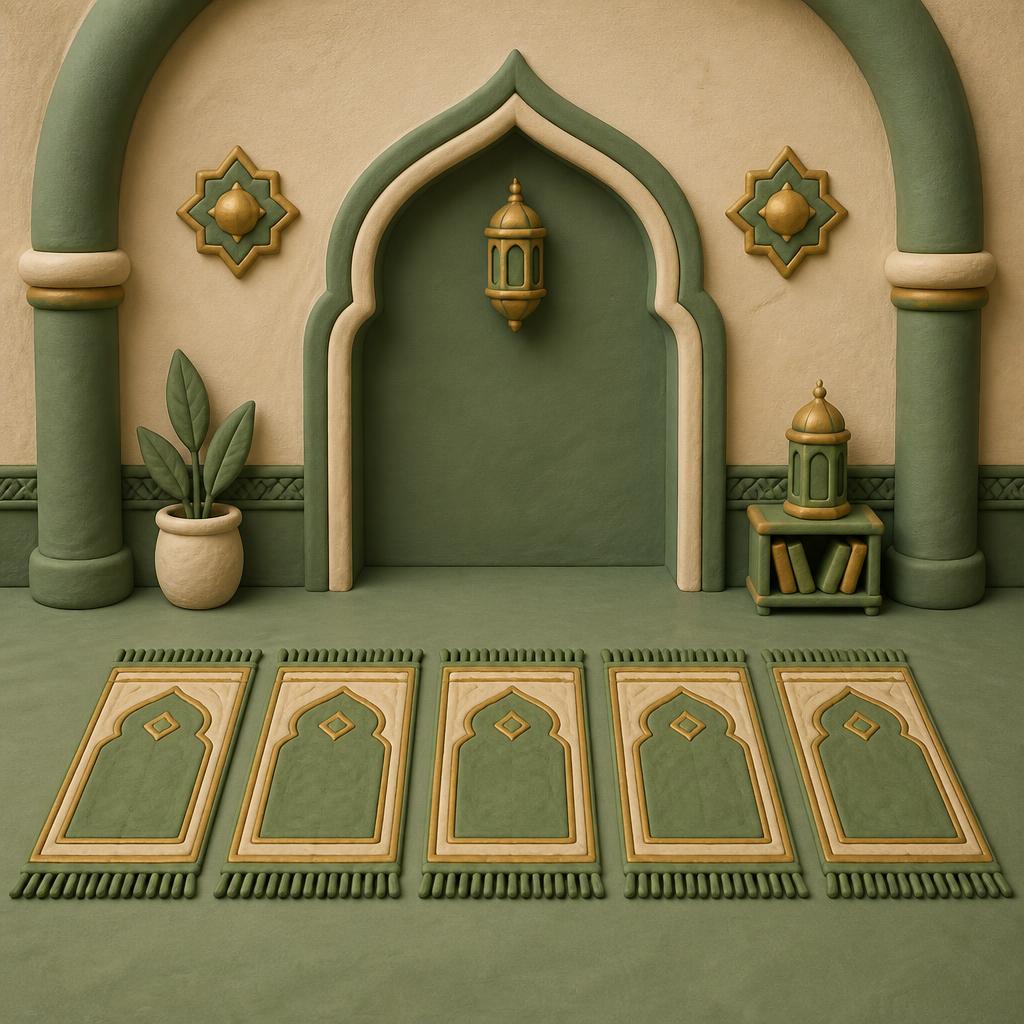
Five identical clay prayer mats laid in a straight row in a simple clay prayer hall with an arched alcove
Five matching sage clay prayer mats laid neatly shoulder to shoulder in a clay prayer hall with an arched niche

Lesson 1 · Salah in jama'ah · ages 8-11

Praying together

Prayer in congregation is worth many times prayer alone, and the row itself is part of the worship.

  1. Multiplied reward

    The Prophet ﷺ said prayer in congregation is twenty-seven times better than prayer offered alone.

  2. Straighten the rows

    The Prophet ﷺ said to straighten the rows, for straightening them is part of the completeness of the prayer.

  3. Follow the imam

    You move after the imam, never before him — the Prophet ﷺ warned sternly about racing ahead of the imam.

  4. Men in the masjid

    Attending the masjid is emphasised for men; women may attend and pray at home with full reward.

  5. Family counts

    Praying together as a family at home is congregation too — a parent leading two children is a jama'ah.

“Prayer in congregation is twenty-seven times superior to a prayer offered by a person alone.”

Sahih Muslim 650

“Straighten your rows, for straightening the rows is part of perfecting the prayer.”

Sahih al-Bukhari 723

Do this before next time

Pray one salah in congregation every day this week — in the masjid or with your family at home.

A small clay house with a glowing gold window resting on a soft clay cloud with a tiny clay prayer mat in front

Lesson 2 · Sunan ar-rawatib · ages 8-11

The twelve extra rak'ahs

Twelve voluntary rak'ahs spread through the day, and the Prophet ﷺ said Allah builds a house in Jannah for whoever prays them.

  1. The promise

    Umm Habibah reported the Prophet ﷺ saying: whoever prays twelve rak'ahs in a day and night, a house in Paradise will be built for him.

  2. Where they go

    In that narration: four before Dhuhr and two after, two after Maghrib, two after Isha, and two before Fajr.

  3. They repair the five

    Voluntary prayers make up for the shortfall in our compulsory ones, so they are not extra credit for the very pious only.

  4. At home is better

    The Prophet ﷺ encouraged praying voluntary prayers at home rather than in the masjid.

  5. Start with two

    Do not attempt all twelve on day one. Take the two after Maghrib and keep them for a month.

“Whoever prays twelve rak'ahs in a day and night, a house in Paradise will be built for him: four before Dhuhr, two after it, two after Maghrib, two after Isha, and two before Fajr.”

Jami' at-Tirmidhi 415

Do this before next time

Pray the two rak'ahs after Maghrib every day this week and mark them off on a chart.

An arched clay window open onto a deep clay night sky with a gold crescent and stars, a small lit clay oil lamp on the sill

Lesson 3 · Qiyam al-layl · ages 12-15

Night prayer and witr

The best prayer after the obligatory ones is the night prayer, and it is finished with an odd number of rak'ahs called witr.

  1. The best voluntary prayer

    The Prophet ﷺ said the best prayer after the obligatory prayers is the night prayer.

  2. Finish with witr

    The Prophet ﷺ said: make the last of your prayer at night an odd number — witr can be one, three, five or more.

  3. How binding is witr?

    Views on witr differ: some scholars treat it as close to compulsory, while most treat it as a strongly recommended sunnah.

  4. Quality over quantity

    The Prophet ﷺ told 'Aishah he prayed a small number of rak'ahs but lengthened them — a few, done well, beats many rushed.

  5. A child-sized start

    Two short rak'ahs before bed, then one witr. That is a complete night prayer.

Surah Al-Israa · 17:79

وَمِنَ ٱلَّيْلِ فَتَهَجَّدْ بِهِۦ نَافِلَةًۭ لَّكَ عَسَىٰٓ أَن يَبْعَثَكَ رَبُّكَ مَقَامًۭا مَّحْمُودًۭا

Wa minal laili fatahajjad bihee naafilatal laka 'asaaa any yab'asaka Rabbuka Maqaamam Mahmoodaa

“And from [part of] the night, pray with it as additional [worship] for you; it is expected that your Lord will resurrect you to a praised station.”

Surah Al-Muzzammil · 73:2

قُمِ ٱلَّيْلَ إِلَّا قَلِيلًۭا

Qumil laila illaa qaleelaa

“Arise [to pray] the night, except for a little -”

“The most excellent prayer after the prescribed prayers is prayer during the night.”

Sahih Muslim 1163

“Make the last of your prayer at night an odd number.”

Sahih al-Bukhari 998

Do this before next time

Pray two rak'ahs and one witr before sleeping, three nights this week.

A gold clay sunrise behind a low sage clay hill with a small clay prayer mat on it and two simple clay bird shapes in the sky

Lesson 4 · Better than the world · ages 8-11

The two rak'ahs before Fajr

Of all the voluntary prayers, the Prophet ﷺ singled out the two small rak'ahs before Fajr as dearer than the whole world.

  1. The hadith

    The Prophet ﷺ said about the two rak'ahs before Fajr: they are dearer to me than the whole world.

  2. He never left them

    This was reported to be the voluntary prayer he was never more regular in keeping than any other.

  3. Keep them short

    The Prophet ﷺ made these two light — this is not the place for long recitation, especially when you are half awake.

  4. Waking for Fajr

    Sleeping early is part of praying Fajr; the sunnah is not to stay up late without need.

  5. If you sleep through

    The Prophet ﷺ said there is no blame in oversleeping — you pray it as soon as you wake.

“The two rak'ahs before the dawn prayer are dearer to me than the whole world.”

Sahih Muslim 725

Do this before next time

Pray the two rak'ahs before Fajr for three days running, even if they are very short.

A round sage clay clock with plain gold hands beside a rolled clay prayer mat and a small gold clay tick

Lesson 5 · Qada · ages 8-11

If you miss a prayer

A missed prayer is not gone. You pray it when you remember — and you never simply skip it as if it never existed.

  1. The instruction

    The Prophet ﷺ said: whoever forgets a prayer should pray it when he remembers it; there is no expiation for it except that.

  2. Oversleeping is not sin

    In the same narration the blame is on neglect, not on genuine sleep or forgetting.

  3. Deliberately leaving it is serious

    Allah warns those who are heedless of their prayer, so a missed prayer is made up quickly, not shrugged off.

  4. Order matters

    If you missed Dhuhr and it is now Asr time, most scholars have you pray the missed Dhuhr first, then Asr.

  5. Fix the cause

    One missed Fajr means the alarm and bedtime need changing, not just a make-up prayer.

Surah Al-Maa'un · 107:4

فَوَيْلٌۭ لِّلْمُصَلِّينَ

Fa wai lul-lil mu salleen

“So woe to those who pray”

Surah Al-Maa'un · 107:5

ٱلَّذِينَ هُمْ عَن صَلَاتِهِمْ سَاهُونَ

Al lazeena hum 'an salaatihim sahoon

“[But] who are heedless of their prayer -”

Surah An-Nisaa · 4:103

فَإِذَا قَضَيْتُمُ ٱلصَّلَوٰةَ فَٱذْكُرُوا۟ ٱللَّهَ قِيَٰمًۭا وَقُعُودًۭا وَعَلَىٰ جُنُوبِكُمْ ۚ فَإِذَا ٱطْمَأْنَنتُمْ فَأَقِيمُوا۟ ٱلصَّلَوٰةَ ۚ إِنَّ ٱلصَّلَوٰةَ كَانَتْ عَلَى ٱلْمُؤْمِنِينَ كِتَٰبًۭا مَّوْقُوتًۭا

Fa izaa qadaitumus Salaata fazkurul laaha qiyaamanw wa qu'oodanw wa 'alaa junoobikum; fa izat maanantum fa aqeemus Salaah; innas Salaata kaanat 'alal mu'mineena kitaabam mawqootaa

“And when you have completed the prayer, remember Allah standing, sitting, or [lying] on your sides. But when you become secure, re-establish [regular] prayer. Indeed, prayer has been decreed upon the believers a decree of specified times.”

“Whoever forgets a prayer should pray it when he remembers it. There is no expiation for it except that.”

Sahih al-Bukhari 597

Do this before next time

Set your own alarm for Fajr tonight instead of relying on a parent to wake you.

A single sage clay prayer mat lit by a soft pool of gold light with a small gold clay heart at its head

Lesson 6 · Khushu · ages 12-15

Praying with your heart

It is possible to complete every movement of salah and still not have been present. Khushu is the part nobody can see.

  1. It is the first quality of the successful

    Allah opens Surah al-Mu'minun by describing the believers as those who are humbly submissive in their prayer.

  2. Ihsan in salah

    The Prophet ﷺ described ihsan as worshipping Allah as though you see Him, and if you cannot, knowing that He sees you.

  3. Not thinking about the prayer

    The Prophet ﷺ warned against the person who prays with no attention, and about Shaytan distracting a person in salah.

  4. Practical helps

    Pray slowly, understand what you are saying, look at the place of sujood, remove noise and clutter in front of you.

  5. Wandering minds are normal

    Everyone's mind drifts. Khushu is bringing it back each time it goes, not never drifting.

Surah Al-Muminoon · 23:1

بِسْمِ ٱللَّهِ ٱلرَّحْمَٰنِ ٱلرَّحِيمِ قَدْ أَفْلَحَ ٱلْمُؤْمِنُونَ

Qad aflahal mu'minoon

“Certainly will the believers have succeeded:”

Surah Al-Muminoon · 23:2

ٱلَّذِينَ هُمْ فِى صَلَاتِهِمْ خَٰشِعُونَ

Allazeena hum fee Salaatihim khaashi'oon

“They who are during their prayer humbly submissive”

Surah Al-Baqara · 2:45

وَٱسْتَعِينُوا۟ بِٱلصَّبْرِ وَٱلصَّلَوٰةِ ۚ وَإِنَّهَا لَكَبِيرَةٌ إِلَّا عَلَى ٱلْخَٰشِعِينَ

Wasta'eenoo bissabri was Salaah; wa innahaa lakabee ratun illaa alal khaashi'een

“And seek help through patience and prayer, and indeed, it is difficult except for the humbly submissive [to Allah]”

“Ihsan is to worship Allah as if you see Him, and if you cannot see Him, then indeed He sees you.”

Sahih Muslim 8

Do this before next time

Pray one salah this week deliberately slowly, and learn the meaning of one phrase you say in it.

A clay road forking into two sage paths with a gold clay compass lying in the foreground

Lesson 7 · Salat al-istikharah · ages 12-15

The prayer for a decision

When a Muslim cannot decide something, there is a prayer for it: two rak'ahs and a dua the Prophet ﷺ taught word for word.

  1. The Prophet ﷺ taught it like the Qur'an

    Jabir said the Prophet ﷺ used to teach them istikharah for all matters, as he taught them a surah of the Qur'an.

  2. How to do it

    Two voluntary rak'ahs, then the dua of istikharah asking Allah to decree it if it is good and turn it away if it is harmful.

  3. It is not a dream

    Istikharah does not promise a vision or a sign. You pray, then you choose with the best judgement you have.

  4. Ask people too

    Allah commands consultation, so istikharah goes alongside asking parents and people with knowledge.

  5. Then be content

    Once you have prayed, consulted and chosen, you trust Allah with the outcome rather than second-guessing forever.

Surah Aal-i-Imraan · 3:159

فَبِمَا رَحْمَةٍۢ مِّنَ ٱللَّهِ لِنتَ لَهُمْ ۖ وَلَوْ كُنتَ فَظًّا غَلِيظَ ٱلْقَلْبِ لَٱنفَضُّوا۟ مِنْ حَوْلِكَ ۖ فَٱعْفُ عَنْهُمْ وَٱسْتَغْفِرْ لَهُمْ وَشَاوِرْهُمْ فِى ٱلْأَمْرِ ۖ فَإِذَا عَزَمْتَ فَتَوَكَّلْ عَلَى ٱللَّهِ ۚ إِنَّ ٱللَّهَ يُحِبُّ ٱلْمُتَوَكِّلِينَ

Fabimaa rahmatim minal laahi linta lahum wa law kunta fazzan ghaleezal qalbi lanfaddoo min hawlika fafu 'anhum wastaghfir lahum wa shaawirhum fil amri fa izaa 'azamta fatawakkal 'alal laah; innallaaha yuhibbul mutawak kileen

“So by mercy from Allah, [O Muhammad], you were lenient with them. And if you had been rude [in speech] and harsh in heart, they would have disbanded from about you. So pardon them and ask forgiveness for them and consult them in the matter. And when you have decided, then rely upon Allah. Indeed, Allah loves those who rely [upon Him].”

Surah Ash-Shura · 42:38

وَٱلَّذِينَ ٱسْتَجَابُوا۟ لِرَبِّهِمْ وَأَقَامُوا۟ ٱلصَّلَوٰةَ وَأَمْرُهُمْ شُورَىٰ بَيْنَهُمْ وَمِمَّا رَزَقْنَٰهُمْ يُنفِقُونَ

Wallazeenas tajaaboo li Rabbhim wa aqaamus Salaata wa amruhum shooraa bainahum wa mimmaa razaqnaahum yunfiqoon

“And those who have responded to their lord and established prayer and whose affair is [determined by] consultation among themselves, and from what We have provided them, they spend.”

“The Prophet ﷺ used to teach us the Istikhara in all matters as he taught us the Suras of the Qur'an.”

Sahih al-Bukhari 1166

Do this before next time

Next time you have a real choice to make, pray two rak'ahs first and ask a parent's advice after.

Every ayah on this page comes from the Tanzil Uthmani text of the Qur'an with the Sahih International translation, and every hadith carries its collection and number so you can check it yourself. Back to the learning path

Next on this shelf: When salah goes wrong — 5 lessons.

1-to-1 lessons

Go deeper into salah in depth

A teacher can answer your child's questions properly, check their understanding, and take this further at their own pace.

Book a tutor for this